

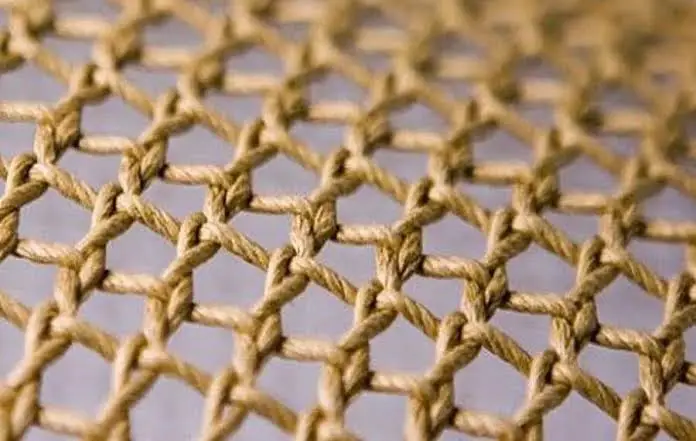
Open-structure fabrics such as gauze and mesh play a critical role in technical textiles, medical applications, agriculture, and lightweight industrial materials. However, producing these fabrics with stability and precision has always been a challenge using conventional weaving methods.
This is where gauze weave — also known as leno weave — becomes essential.
In this article, we explain what gauze weave is, why it is important, and how modern leno systems allow manufacturers to produce gauze fabrics efficiently on dobby looms.
What is Gauze Weave?
Gauze weave is a special weaving technique in which pairs of warp yarns twist around the weft yarn, locking it securely in place.
Unlike plain weave, where warp yarns run parallel, gauze weave introduces a crossing motion that stabilizes the fabric structure.
Key characteristics of gauze weave:
✔ open and breathable structure
✔ high dimensional stability
✔ resistance to yarn slippage
✔ lightweight construction
✔ uniform mesh openings
Because of these properties, gauze fabrics are widely used in both traditional and technical applications.
Why Gauze Weave is Important in Modern Textiles
As industries move toward lightweight and high-performance materials, gauze weave offers unique advantages:
✔ Stability in Open Structures
Prevents deformation even with large mesh openings.
✔ Material Efficiency
Uses less yarn while maintaining strength.
✔ Airflow and Transparency
Ideal for applications requiring ventilation or light transmission.
✔ Versatility
Can be used in agriculture, medical textiles, filtration, and industrial fabrics.
Applications of Gauze (Leno) Fabrics
Gauze weave is used in a wide range of industries:
Agriculture
- insect protection nets
- shading fabrics
- crop support meshes
Medical & Hygiene
- bandages and medical gauze
- breathable textile materials
Technical & Industrial
- filtration fabrics
- reinforcement scrims
- lightweight composite supports
Packaging & Others
- protective mesh fabrics
- ventilation textiles
These applications require both openness and structural integrity — something gauze weave provides effectively.
Challenges in Producing Gauze Fabrics
Despite its advantages, gauze weaving is not easily achieved on standard looms without modification.
Common challenges include:
- inability to control warp crossing
- yarn slippage in open structures
- inconsistent mesh formation
- limited production flexibility
To overcome these issues, a specialized leno system is required.
How a Leno System Enables Gauze Weaving on Dobby Looms
A leno system adds the mechanical capability needed to create the warp crossing motion required for gauze weave.
How it works:
- Leno devices control selected warp yarns.
- Warp yarns twist around the weft during insertion.
- The crossing locks the yarns in position.
- A stable and uniform open fabric is formed.
This allows dobby looms to produce gauze fabrics efficiently and consistently.
Technical Configuration of the System
The leno system can be adapted based on loom width and production requirements.
For Looms from 3.0 m to 3.8 m:
- 8 frames
- 24 leno devices (12 upper and 12 lower)
- 6,400 knitting healds
- metal support bar system
For Looms from 1.90 m to 3.0 m:
- 18 leno devices
- 4,800 knitting healds
This ensures consistent gauze formation across different machine sizes.
Knitting Heald Options for Gauze Fabrics
To support different yarn types and fabric structures, two heald sizes are available:
✔ 2.04 mm
Suitable for thicker yarns and stronger gauze structures.
✔ 1.40 mm
Ideal for fine yarns and lightweight gauze fabrics.
Selecting the correct heald ensures smooth operation and high-quality results.
Flexible Installation Options
Manufacturers can choose between:
✔ Complete Frame Supply
Ready-to-install system for quick implementation.
✔ Adapting Existing Frames
Existing frames can be modified by:
- precision drilling
- device positioning according to loom width
- alignment based on machine model
This reduces investment while maintaining performance.
Machine Compatibility
The leno system is compatible with:
✔ Rapier Looms
Operating speed: 250 – 350 rpm
✔ Airjet Looms
Operating speed: 450 – 550 rpm
❌ Not compatible with water jet looms
Benefits of Producing Gauze Fabrics with a Leno System
✔ stable and uniform open structures
✔ reduced yarn consumption
✔ improved fabric durability
✔ flexibility in mesh design
✔ ability to produce technical and high-value fabrics
This enables manufacturers to enter new markets and improve profitability.
Conclusion
Gauze weave is a highly effective structure for producing open, stable, and lightweight fabrics across multiple industries. With the integration of a leno system, dobby looms can be transformed into powerful tools for gauze fabric production.
This approach allows textile manufacturers to expand their capabilities, reduce investment costs, and meet the growing demand for technical and breathable fabrics.
 English
  Turkish
  Spanish